



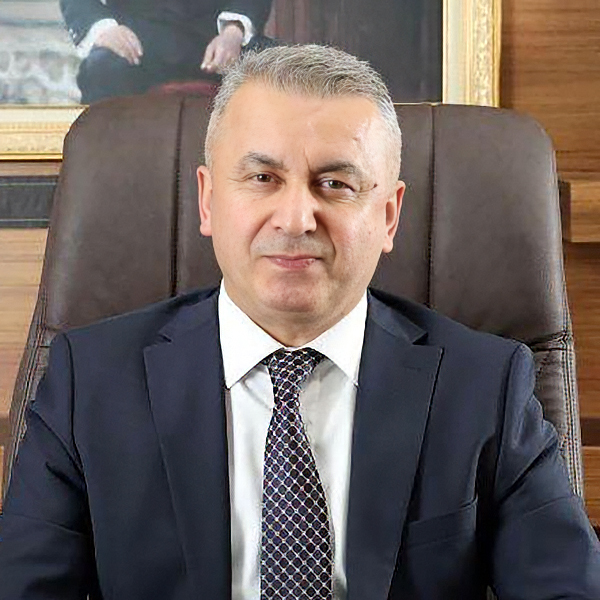
YÜKSEL YALÇIN
Energy Management in Local Governments
Abstract
The presentation addresses energy management in local governments, along with its role in the fight against climate change. Energy management is no longer merely a technical issue. It is a strategic management area that directly impacts the quality of municipal services, financial sustainability, climate goals, and the future of urban life. For this reason, the presentation evaluates both the global climate agenda and the responsibilities cities must assume within this agenda.
Climate change is no longer a distant risk for the future; it has become one of the fundamental realities cities face today. The temperature anomaly visuals included in the presentation clearly demonstrate how the world has changed from 1880 to 2025. According to the data, the world will be approximately 1.44 °C warmer in 2025 compared to the pre-industrial average. Additionally, the last 10 years stand out as the hottest on record. This picture demonstrates that the climate crisis is not merely an environmental issue but also an economic, social, and urban governance challenge. Therefore, the new normal for cities must be built on adapting to climate change, reducing greenhouse gas emissions, and managing resources more intelligently.
Globally, greenhouse gas emissions continue to rise. As seen in the graphs in the presentation, global total greenhouse gas emissions reached 53,200 million metric tons of CO₂ equivalent in 2024. A similar upward trend is observed in Turkey. While Turkey’s total greenhouse gas emissions stood at 229 million tons in 1990, they rose to 584.5 million tons by 2024. This increase highlights the need for stronger and more comprehensive policies in sectors such as energy, transportation, industry, buildings, and waste management. Local governments play a critical role in this context.
This is because a significant portion of emissions originates in cities, and cities are also where solutions must be implemented.
Combating climate change has been a key item on the international agenda for many years. The process, which began with the 1992 Rio Summit, has gained a stronger framework through the 1997 Kyoto Protocol, the 2005 C40 initiative, the 2015 Sustainable Development Goals, and the Paris Climate Agreement. In 2019, the European Green Deal made emission reductions, the decoupling of economic growth from resource use, and green transition goals more concrete. In Turkey, climate policies have taken on a clearer direction with the entry into force of the Paris Climate Agreement. This process demonstrates that combating climate change can only be achieved not only through national policies but also through actionable and measurable initiatives at the local level.
Cities are both a major source of the climate crisis and one of the areas most vulnerable to its impacts. Covering approximately 3% of the Earth’s land area, cities account for roughly 70% of global emissions. This ratio clearly highlights the decisive role cities play in climate policies. Additionally, energy demand in cities is increasing day by day. Growing populations, expanding service sectors, transportation demands, infrastructure needs, and the building stock are making energy consumption more complex for local governments. Traditional infrastructure may prove insufficient to meet these needs and hinder sustainability goals. Extreme weather events, the urban heat island effect, drought, and infrastructure vulnerability also directly impact cities. Therefore, the strategic solution lies in integrating energy management with the smart city approach. A smart city is a management ecosystem that uses digital technologies to monitor energy consumption, manage resources efficiently, reduce emissions, and align urban services with climate goals.
One of the most important tools for local governments is the Sustainable Energy and Climate Action Plan (SECAP). SECAP is a strategic plan that identifies a city’s current greenhouse gas emissions status, assesses climate risks, sets reduction targets, and defines concrete actions to achieve these goals. SECAP is not merely a report. It is a roadmap that makes a local government’s energy and climate vision manageable by incorporating timelines, responsibilities, stakeholders, estimated impacts, and monitoring processes. In this context, long-term goals such as a 40% emissions reduction by 2030 and a carbon-neutral target by 2050 guide local governments’ decision-making processes. The SECAP approach offers a framework applicable not only to municipalities but also to industrial zones, universities, campuses, public institutions, and private-sector organizations.
SECAP initiatives in local governments include steps such as employee training, greenhouse gas emission reduction targets, renewable energy systems, smart lighting, electric vehicle charging stations, efficient waste management, and stakeholder-participatory workshops. Industrial
Biyografi
Yüksel Yalçın was born in 1970. He completed his bachelor’s degree in Industrial Engineering at Yıldız Technical University in 1992. He earned his master’s degree in General Management from Beykent University and his Ph.D. in Business Administration from Istanbul Aydın University, thereby obtaining his doctoral degree.
Yalçın began his professional career in 1992, initially working in the automotive sector in Quality Management and in the lighting sector in Production Planning and Quality Management. Through the consulting firm he founded, he conducted Management Systems Consulting projects for numerous companies, primarily in the manufacturing sector. Subsequently, Yalçın served for nearly 25 years at Öztiryakiler, a company in the industrial kitchen sector with Japanese partners, including the last 7 years as General Manager. As of November 2020, he was appointed General Manager of İstanbul Enerji AŞ, a subsidiary of the Istanbul Metropolitan Municipality (İBB), As of February 2022, he concurrently serves as General Manager and Chairman of the Board of Directors at İSETAŞ, another subsidiary of the Istanbul Metropolitan Municipality (İBB). In the academic sphere, he continues his work as an instructor for undergraduate courses at Istanbul Kultur University and graduate-level courses at Istanbul Aydin University. Dr. Yüksel Yalçın currently serves as Chairman of the Board of Directors at GÜSİAD, and concurrently holds positions including Board Member at BEYSİAD, Chairman of the Advisory Board at BÜYİD, Vice Chairman of the Board of Trustees at Yıldız Technical University Foundation, Board Member at Gümüşhane University Foundation, and Member of the Sector Advisory Board at Gelişim University. Previously, he held key positions in technical-based NGOs such as the Turkish Engineers’ Union Board of Directors, GÜMÜP Presidency, and the Turkish Cogeneration Association. He has served on juries and committees for project management education coordination in project competitions organized under TİM-İDMMİB,
coordinated the YTÜ-SEM Education Program for the state-supported Turquality Program, contributed to National Branding Programs, presented Social Compliance Programs to global companies in Belgium, and provided training on management systems such as Strategic Human Resources Management, Strategic Entrepreneurship, and Project Management, contributing to training programs for private sector participants and numerous universities.
He has authored four published books and has numerous national and international published articles. Dr. Yüksel Yalçın is married and the father of three children.